Custom Stickers Factory for Your Brand – Guides, Materials & Customization Hacks

Custom Stickers Factory for Your Brand – Guides, Materials & Customization Hacks
 Xinyin
 Oct 12,2026

Custom shaker stickers (also known as liquid filled shaker stickers, glitter shaker stickers) are popular 3D moving stickers for planners, tumblers, stationery and kids gift sets. Custom shaker stickers are popular for their three-dimensional appearance and moving liquid effects.
With floating glitter, sequins, and other decorative elements inside a transparent shell, 3D liquid shaker stickers offer a distinctive option for stationery brands, gift companies, promotional merchandise suppliers, and character merchandise collections. Customers love the dynamic visual effect when glitter or liquid flows inside the vacuum formed cavity.
However, leakage is one of the key quality risks in liquid-filled shaker sticker manufacturing. A sticker may look attractive while still having a weak seal or a small gap that allows liquid to escape during handling, storage, or transportation. A leaking custom shaker sticker ruins end-user experience, increases product returns and damages brand reputation.
For brands sourcing custom shaker stickers wholesale, preventing leakage requires attention to the entire product structure, from 3D shell forming and filling to sealing, inspection, and packaging.
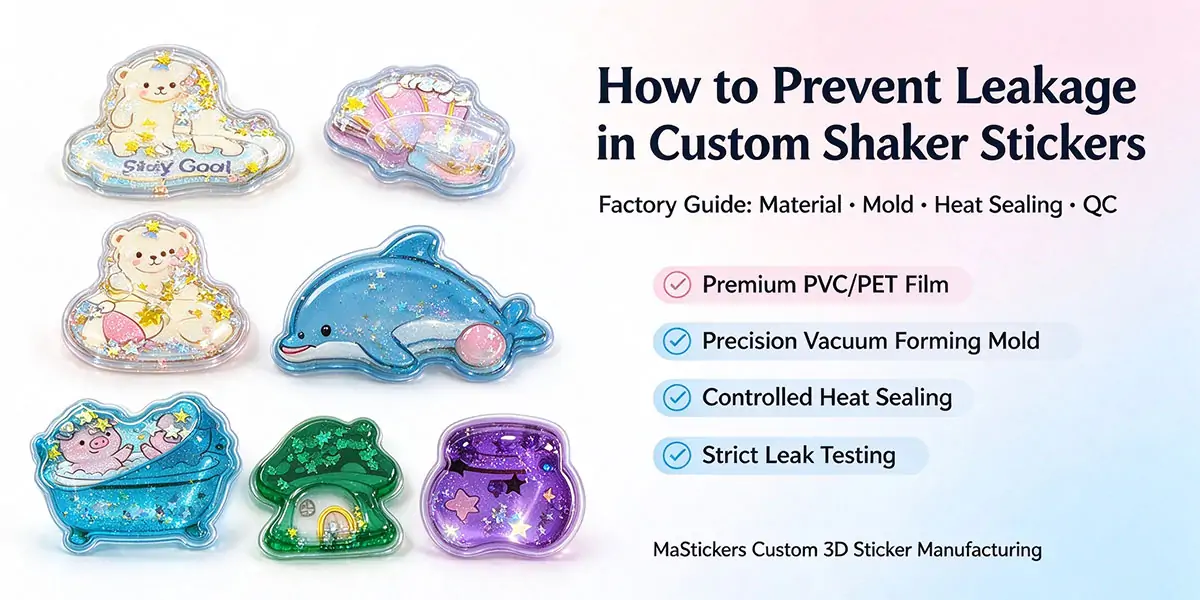
Most sticker leakage issues with swing labels stem from the following key vulnerabilities in the manufacturing process.
Poor vacuum forming mold tolerance. Shaker stickers use vacuum forming to create the raised cavity, similar to blister packaging. If the mold contour has uneven edges or rough burrs, sharp edges will puncture the thermoformed film during heat sealing or die cutting.
Contamination on sealing edges. Dust, glitter particles or liquid residue trapped on the seal border stops the heat seal from bonding completely, creating tiny invisible gaps.
Incorrect heat sealing parameters. Too low temperature or insufficient pressure creates partial weak seals. Overheating burns the PVC/PET film and creates micro holes on the sealing rim.
Post-cut edge damage. Improper die cutting can create micro cracks along the sealed perimeter, which slowly expand under temperature changes during shipping and storage.
The sealing film material. Low-quality or incorrectly specified film cannot maintain a consistent barrier.
The sealing process. Incomplete adhesion, air pockets, or misalignment during film application.
The liquid and filler combination. Incompatible liquids or overfilled stickers create internal pressure that compromises the seal.
Material compatibility is essential to creating a reliable liquid-filled structure. The shell, cover layer, and sealing materials must work together under the selected production process. A material combination that looks suitable may not form a sufficiently strong bond under actual manufacturing conditions.
Select compatible high-barrier thermoformed films. We use premium PVC and PET films for custom liquid shaker stickers. These flexible thermoplastic sheets offer good tear resistance and stable heat-sealing performance. Thin, low-grade recycled films easily stretch, puncture or develop pinholes.
Base Material: Transparent PVC for Clarity and Durability. The outer body of a shaker sticker is typically made from transparent PVC. PVC offers excellent clarity, flexibility, and resistance to moisture. And all essential for a product that contains liquid. Thicker PVC provides a more rigid structure that helps maintain the seal under handling and temperature changes.
Sealing Film: PET Is the Industry Standard. The most critical component of a shaker sticker is the sealing film that encloses the liquid. Industry data shows that high-quality sealing films made from PET plastic offer the best combination of transparency, flexibility, and barrier performance. These films are bend-resistant and tasteless, and when properly applied, they create a reliable seal that prevents liquid from escaping.
At MaStickers (Xinyin), we specify PET sealing films with a thickness of 0.2 mm as our baseline. This is the same specification used in professional resin shaker applications, where a secure seal is equally critical. For larger or high-use shaker stickers, we can increase film thickness to improve durability.
When developing custom liquid shaker stickers, manufacturers should consider:
Do not assume that every transparent film or adhesive can provide the same sealing performance. The correct material combination should be confirmed through production trials and sample evaluation.
The liquid inside a shaker sticker affects both the visual effect and the sealing requirements. Water is the most common medium, but it can evaporate over time if the seal is imperfect. Mineral oil is an alternative used in many premium shaker stickers; it does not evaporate, and its higher viscosity creates a slower, more luxurious movement of glitter and sequins. However, mineral oil requires a more robust seal because it can penetrate certain adhesives over time. (Reference: What Can You Put Inside Custom Shaker Stickers?)
For brands that need long-term stability without maintenance, mineral oil is often the better choice. For cost-sensitive projects, water-based fillers remain viable when paired with a correctly applied PET seal.
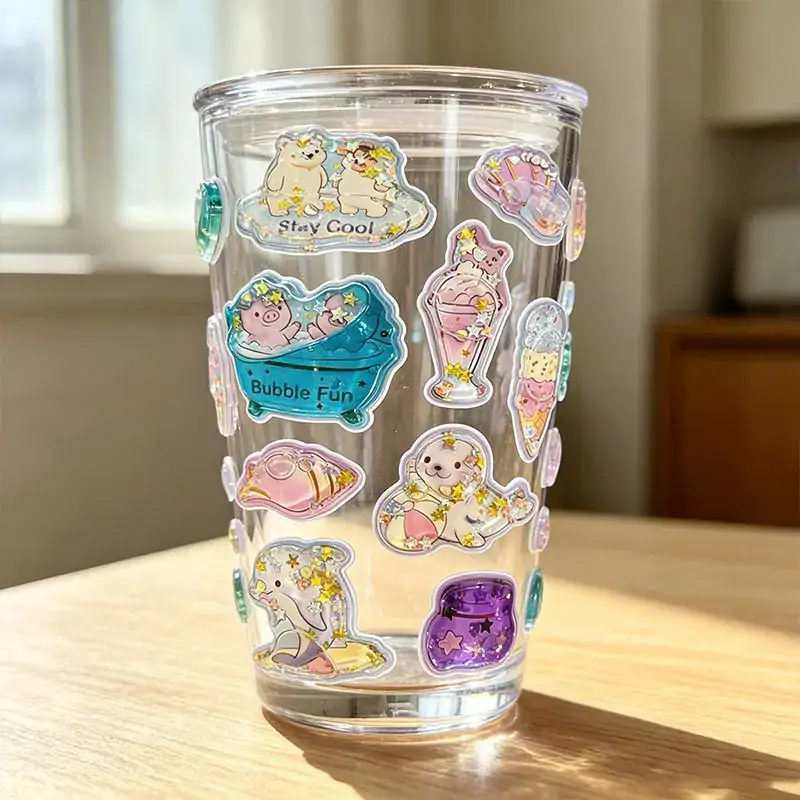
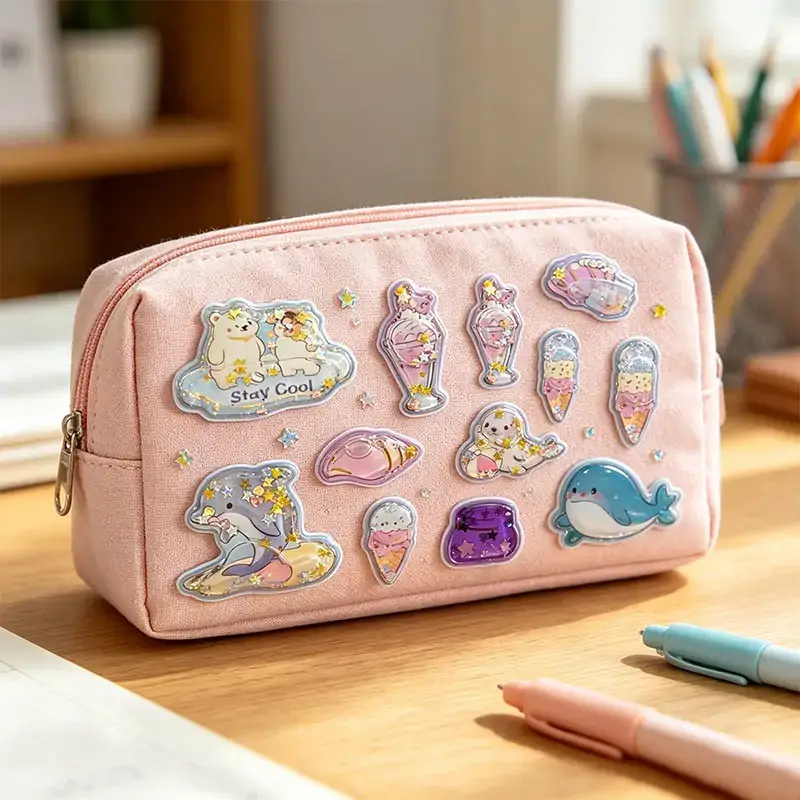
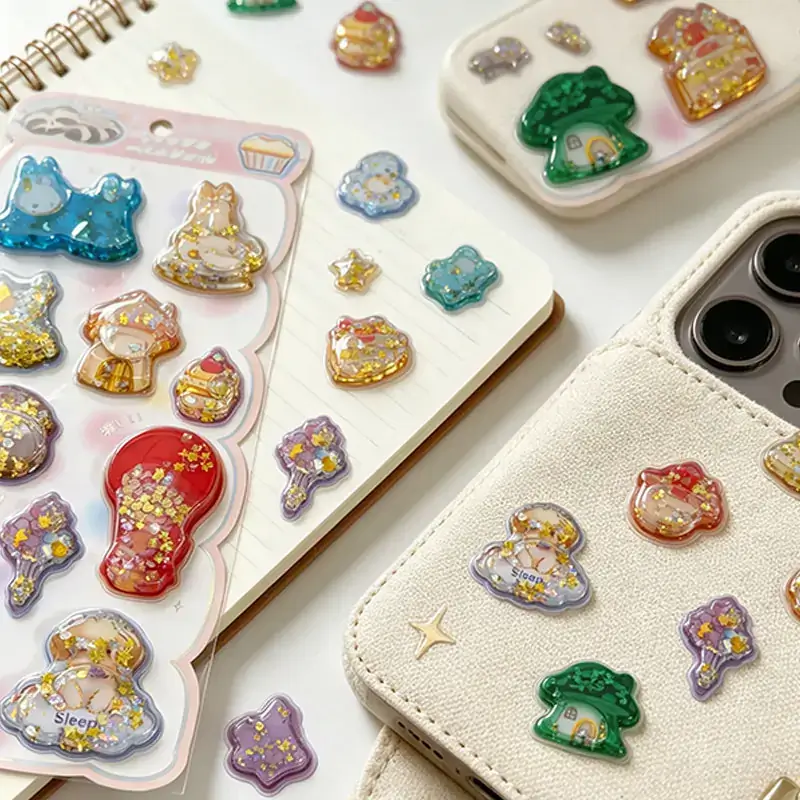
Custom 3D stickers need molds, shaker stickers rely on custom vacuum forming molds to shape each 3D cavity. We polish every mold edge. We reserve a flat, wide sealing border around each shaker pocket. This flat margin provides a clean, stable area for heat bonding, avoiding seal failure caused by curved or uneven edges. Complex custom shapes require extra mold polishing to eliminate sharp corners that may tear the film. (Reference: Why Do Custom 3D Stickers Need Molds?)
A typical 3D liquid shaker sticker uses a raised shell or cavity to contain liquid and decorative fillers. In MaStickers' shaker sticker product range, the transparent PVC structure creates space for the liquid, glitter, and sequins to move.
When developing a custom design, manufacturers should review:
A highly irregular outline may create more challenging forming and sealing conditions than a simple shape. Reviewing the structure before making the forming tool helps identify potential weak points early.
For OEM buyers: Provide the final artwork and intended dimensions, and ask the manufacturer to review both the 3D cavity and the sealing area before approving the design.
The sealing stage is one of the most important steps in preventing leakage. Depending on the product construction and material combination, a manufacturer may use a suitable heat-sealing or other compatible bonding process. The method should be selected according to the actual structure rather than assumed to be identical across all shaker sticker designs.
Important process factors may include:
Material alone does not prevent leaks. The way the sealing film is applied determines whether the sticker will hold. If the sealing conditions are insufficient, some areas may not bond completely. If conditions are unsuitable for the material, the shell may deform or the sealing surface may become inconsistent.
A seal that looks complete is not necessarily leak-resistant. Wrinkles, contamination, weak bonding, and small gaps can compromise seal integrity. For this reason, sealing parameters should be established and verified during sample development, then monitored during mass production.
Dust and moisture are the enemies of a reliable seal. In our factory, sealing film application takes place in a controlled environment with filtered air and low humidity. A single particle of dust trapped between the film and the PVC surface can create a micro-channel for liquid to escape.
The sealing film must be aligned precisely with the sticker's cut line. Industry templates typically require a safe line and bleed line positioned 1.5 mm from the cut line to ensure full coverage. During application, we use calibrated rollers to apply uniform pressure across the entire film surface. Uneven pressure leaves air pockets that expand and contract with temperature changes, eventually breaking the seal.
Our factory cleans every cavity edge before filling glitter or liquid. We remove stray glitter, dust and liquid droplets to guarantee no foreign particles sit on the seal line. We calibrate heat sealing temperature, dwell time and pressure for each shaker sticker size and material. Consistent heat pressure fully fuses the top and bottom film layers across the whole perimeter, eliminating micro gaps. All heat-sealed borders receive visual inspection right after sealing.
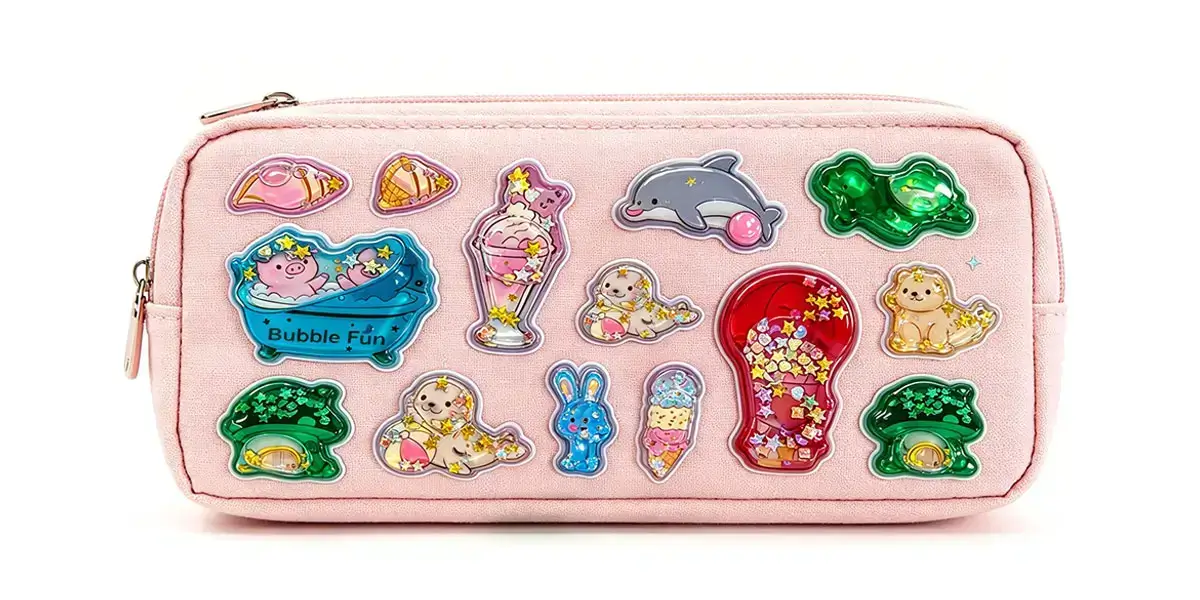
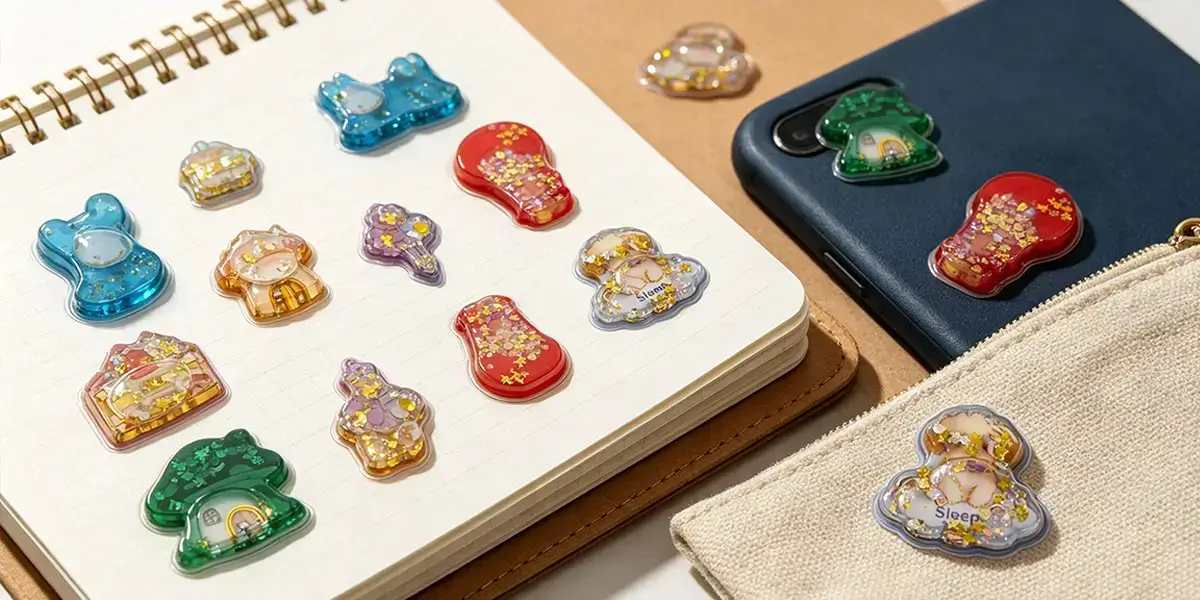
The liquid and floating decorations create the characteristic shaking effect, but the filling process also affects sealing reliability. Depending on the design, the contents may include liquid, glitter, sequins, or small decorative shapes. If liquid or particles reach the sealing area, they may interfere with the bond.
To reduce this risk, manufacturers should:
Avoid overfilling the cavity. The correct filling quantity should leave sufficient room for the intended movement effect and allow the structure to be sealed properly.
The ideal filling level depends on the cavity dimensions, liquid characteristics, and size of the decorative elements. It should be established through prototype testing rather than a universal percentage.
The external contour of a custom shaker sticker can be complex, especially for cartoon characters, mascots, and irregular shapes.
However, the cutting stage should not compromise the sealed cavity. The relationship between the cavity edge, sealing area, and final cutting contour must be considered during design and tooling development.
A practical production workflow is:
The exact order of printing and preparation depends on the product construction. (Reference: How Are 3D Stickers Manufactured? Step-by-Step Production Process)
Before final cutting, custom liquid-filled shaker stickers manufacturers should check whether the sealing area is continuous and whether any visible defects are present. After cutting, they should also confirm that the finished outline has not exposed or damaged the sealed chamber. This is particularly important for custom 3D shaker stickers with narrow sections or complex silhouettes.
The most important thing we tell our B2B clients is this: leak testing on shaker stickers must be 100%, not a sample-based AQL (Acceptable Quality Limit) check. Visual defects can follow an AQL protocol. Leakage cannot. A single leaking sticker in a retail pack can generate a customer complaint, a return, and a negative review.
For this reason, our production line runs a inverted leak check on every shaker sticker before packing. Each sticker is filled, sealed, inverted, and observed for a minimum hold period. Any sticker showing moisture at the seal edge is pulled from the line and reworked or discarded.
A perfect seal at the factory can still fail if the stickers are stored or shipped improperly. We recommend the following guidelines for our B2B partners:
Avoid extreme temperatures. Both water-based and oil-based shaker stickers can be affected by freezing or prolonged exposure to heat above 40°C. Store in a climate-controlled warehouse.
Keep flat during transport. Bending or flexing a shaker sticker repeatedly can stress the seal. We pack shaker stickers flat between rigid backing cards.
Custom liquid filled shaker stickers should be packed in a way that protects the formed shell and sealed edges from unnecessary pressure, sharp objects, and deformation.
For bulk OEM orders, buyers and manufacturers should consider:
For international shipments, packaging evaluation should reflect the intended transport method and distribution conditions. The appropriate protection depends on the product dimensions, packaging format, order quantity, and shipping route.
When you prepare artwork for custom shaker stickers, you can reduce leakage risk at the design stage:
Keep sealed border wide enough; avoid ultra-narrow seal lines on complex tiny shapes.
Minimize sharp tight corners on your shaker sticker outline, as sharp corners are the most common leak points.
Discuss your filling material (liquid, glitter mix) with our engineering team. Different filler types require adjusted sealing parameters.
Request pre-production shaker sticker samples for leak testing before full mass production.
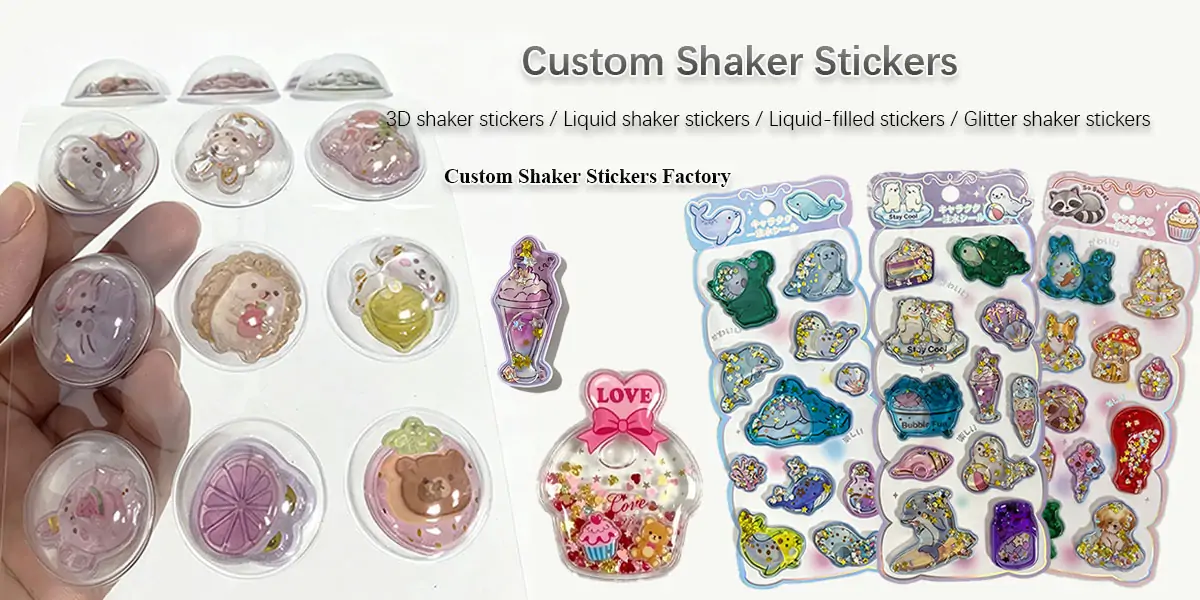
MaStickers specializes in OEM & ODM custom 3D stickers, including custom shaker stickers, 3D puffy stickers and vacuum formed 3D decals. We own in-house mold workshop, vacuum forming machines and heat sealing lines. We handle everything from custom mold fabrication, printing, thermoforming, filling, sealing, die cutting to final leak QC.
We support small trial runs and large wholesale orders for brand owners, sticker shops and distributors. Our product range supports customized designs, shapes, colors, and liquid-filled effects featuring floating glitter or sequins. Buyers can discuss their artwork and product requirements with the factory to assess the appropriate construction and production plan.
When developing a custom shaker sticker project, the key considerations include:
Custom artwork and sticker contours
3D shell structure and cavity design
Liquid and decorative filler effects
Sealing and leakage inspection requirements
Adhesive backing and finished sticker format
Bulk production and packaging requirements
Every design has its own structural requirements. Reviewing these details before mass production helps establish a more suitable manufacturing and quality-control plan.
If you are sourcing a custom shaker sticker manufacturer for OEM/ODM bulk orders, contact MaStickers to discuss your artwork, preferred liquid effect, target quantity, and quality requirements.
Leakage is not an inevitable risk of shaker sticker production. It is a specification problem.
Preventing leakage in custom shaker stickers requires more than applying a seal around a transparent shell. It involves coordinated control of the 3D cavity design, material compatibility, filling process, sealing conditions, contour cutting, inspection, and packaging.
For buyers sourcing 3D liquid shaker stickers wholesale, the most effective approach is to review the product structure early, approve a representative sample, and agree on a practical leak-testing plan before mass production.
A well-defined manufacturing and inspection process helps reduce avoidable leakage risks and supports more consistent quality across bulk orders.
If you are sourcing custom shaker stickers for retail, promotional campaigns, or licensed merchandise, we invite you to request a quote and sample from MaStickers. We will walk you through the material options, share our leak testing protocol, and produce a sample batch that meets your brand’s quality standard.
Contact MaStickers today to start your custom shaker sticker project.
Q: Can you produce shaker stickers with custom shapes and liquid fill levels?
A: Yes. We support fully custom die-cut shapes, and the liquid fill level can be adjusted to control the speed and density of the glitter movement. For very small or intricate shapes, we may recommend a higher-viscosity liquid to ensure consistent movement.
Q: What is the minimum order quantity for custom shaker stickers?
A: Our standard MOQ for custom shaker stickers is 1,000 pieces per design. For brands testing the market, we offer smaller trial runs at a higher unit cost.
Q: Are custom shaker stickers fully waterproof and leak-proof?
A: Our factory manufacturing process greatly reduces leakage risk, but extreme sharp impact or prolonged high temperature can still damage the sealed pouch. We perform strict leak QC to minimize failure rates for bulk orders.
Q: Can I customize the liquid and glitter inside shaker stickers?
A: Yes. We offer different glitter colors, particle sizes and safe liquid formulas. Our engineering team will adjust heat sealing settings according to your filler selection.
 You May Also Like
No 410, Laoyi Village, Niuhu Community, Guanlan Street, Longhua District, Shenzhen City

MaStickers
Custom Stickers Manufacturer

No 410, Laoyi Village, Niuhu Community, Guanlan Street, Longhua District, Shenzhen City
Product
Get in touch and find out how we canmake your next shipment easier.


Copyright © 2026 Shenzhen Xinyin Environment Rubber Product Co., Ltd



 Home
Home