Custom Stickers Factory for Your Brand – Guides, Materials & Customization Hacks

Custom Stickers Factory for Your Brand – Guides, Materials & Customization Hacks
 Xinyin
 Sep 30,2026

Traditional flat stickers are mainly visual. Flocked puffy stickers add another dimension by combining a raised 3D shape with a soft, fuzzy surface texture. For stationery brands looking to develop distinctive sticker collections, this finish creates a different experience from conventional glossy 3D puffy stickers. The raised structure provides dimensionality, while the flocked surface gives the sticker a soft, velvet-like tactile effect.
Today, similar products can be found under names such as 3D flocked stickers, flocked puffy stickers, and flocked 3D gel stickers. The term "flocked" generally refers to a surface finished with fine fibers that create a soft, suede- or velvet-like texture.
Also known as velvet stickers, fuzzy stickers, or flocked drop stickers (a term popularized in Japan as フロッキードロップシール), these stickers are transforming how brands connect with consumers. Let's explore what makes them special and why they deserve a place in your next product line.
Flocked puffy stickers are 3D raised stickers with a flocked surface finish. This process (called flocking) creates a soft, velvet-like texture that mimics the feel of felt or plush fabric while maintaining the signature raised, raised-like shape of a puffy sticker.
The basic concept starts with a dimensional 3D puffy or Bonbon Drop-style sticker structure. A flocked layer is then added to the surface, changing the original smooth finish into a soft, fuzzy texture. Compared with glossy resin or smooth 3D stickers, flocked versions have a more tactile appearance. The surface can resemble velvet, suede, or felt visually, creating a cozy and plush impression.
In the current Japanese-inspired stationery market, similar products are also described as FuwaFuwa Drop style stickers (FuwaFuwa Drop Flocky Seal) or flocked 3D stickers. These stickers as combining a flocked surface with the familiar puffy 3D dimension.
Texture: They have a fuzzy, soft, and cozy outer layer with a raised 3D puffy shape underneath.
Popular Brands: Widely known as Bonbon Drop stickers or Fuwafuwa Drop stickers, produced by stationery brands like Q-lia and Kamio Japan.
Uses: Great for decorating phone cases, journals, planners, water bottles, and laptops due to their strong adhesive backing.
Aesthetics: Heavily tied to Japanese and Korean kawaii, and collectible stationery trends.
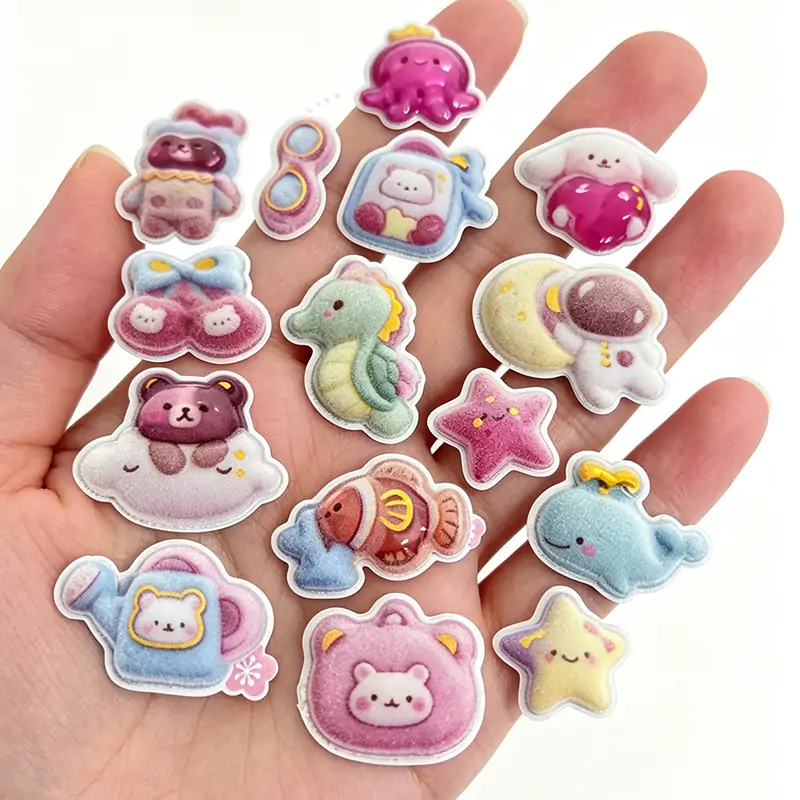
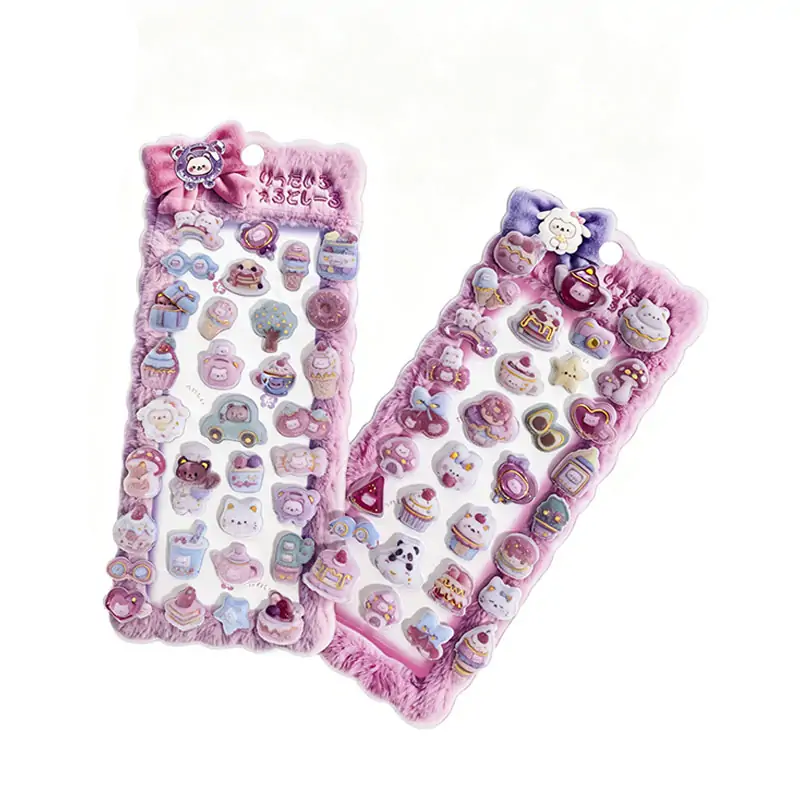
The visual appeal of a flocked sticker comes from the combination of shape, color and surface texture. A conventional 3D sticker can create depth through its raised profile. Adding flocking introduces a second visual layer: instead of reflecting light from a smooth surface, the fine fibers create a softer, matte-looking appearance.
This makes flocked stickers particularly suitable for designs that are intended to look:
For kawaii stationery, animal characters, desserts, winter scenes and soft-color collections, this combination can create a noticeably different product aesthetic.
The stationery market contains a large number of flat paper, vinyl and glossy 3D stickers. A flocked 3D sticker adds another surface effect that can help a collection stand apart.
Instead of relying only on artwork, brands can use texture as part of the product design.
For example, an animal character can have a raised body with a soft flocked finish, while selected details can remain smooth or glossy.
One of the main characteristics of flocking is its soft, raised fiber texture. Flocking is commonly used to create a velvet-like or suede-like surface that can be seen and felt.
For stationery brands, this creates an additional sensory element that standard printed stickers cannot provide.
Three-dimensional stickers have become an important part of the current Japanese and Asian-inspired stationery trend.
A 2026 overview of Japan's sticker boom highlights Bonbon Drop stickers as a major 3D sticker style and specifically identifies fluffy/flocked versions as a distinctive variation with a soft, fuzzy surface.
For brands developing new collections, flocking therefore provides a way to build on the popularity of 3D sticker formats while introducing a different surface treatment.
The soft texture naturally works well with visual themes associated with winter and coziness. For example:
This makes flocked winter stickers and 3D fuzzy stickers useful concepts for seasonal stationery collections.
A major advantage for stationery brands is that flocking can be treated as a surface design option.
The same basic character concept can potentially be developed into different finishes:
This gives brands more ways to create collections around an existing character or artwork system.
For OEM and wholesale production, the flocking effect should be considered together with the original 3D structure.
3D Profile: The raised structure should support the artwork and leave enough visual definition for the flocked surface.
Flocking Coverage: Brands can consider whether the flocked effect should cover the entire 3D surface or only selected areas. Partial flocking can create contrast between soft and smooth surfaces, making small details more visible.
Color Matching: Flock colors should be considered alongside the printed artwork and 3D base color to achieve the intended visual style.
Character Details: Simple, recognizable shapes often work particularly well with tactile finishes because the 3D silhouette remains easy to recognize.
Sticker Sheet Presentation: For wholesale stationery products, the backing card, sticker sheet layout and packaging can also be customized to match the brand's collection.
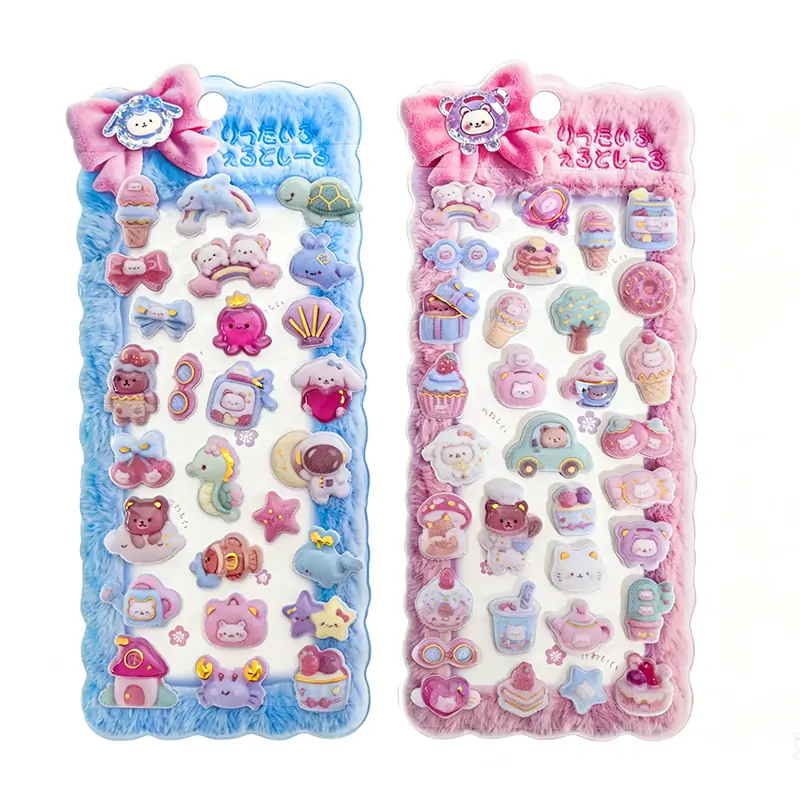
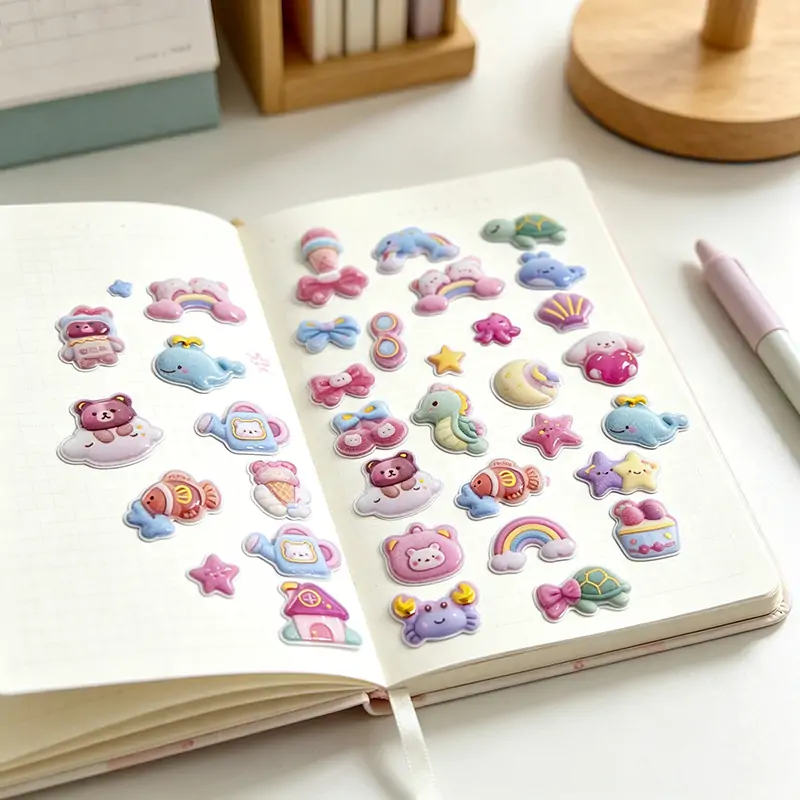
At Mastickers, our custom flocked puffy stickers combine the best of both worlds: the dimension of 3D puffy stickers and the tactile luxury of flocking. Here's how we do it:
Step 1 - 3D Relief Mold Development (Tooling): For vacuum thermoformed 3D puffy stickers, custom mold tooling is required. We develop precision molds based on your artwork to define the raised 3D relief, shape, depth, and edges. This mold-making step is essential for achieving consistent, repeatable 3D embossed puffy stickers.
Step 2 - 3D Forming: The top sheet material (PVC or PU) is heated and shaped into a raised 3D design using vacuum thermoforming or embossing. This creates the signature puffy silhouette.
Step 3 – Flocking Application: Fine fibers (nylon, rayon, or polyester) are electrostatically applied to the surface of the 3D shape. The electrostatic charge ensures that each fiber stands upright, creating a dense, velvet-like pile.
Step 4 – Resin Filling: Epoxy resin is injected into the hollow interior of the raised shape for structural integrity and durability.
Step 5 – Curing: The resin filling and flocking adhesive are cured to ensure permanent bonding and shape retention.
Step 6 – Base Layer & Die-Cutting: A printed base layer featuring full-color artwork is applied beneath the 3D structure, followed by adhesive backing, precision die-cutting, and waste removal.
For stationery brands, distributors and wholesalers, flocking can be incorporated into a broader custom 3D sticker manufacturing program.
At MaStickers, custom sticker production can be developed around customer artwork, including 3D puffy and other specialty sticker formats. The company's existing OEM/ODM service covers customized sticker production and supports different manufacturing requirements for commercial projects.
A typical OEM development process can include:
For a custom flocked puffy sticker project, buyers should provide or confirm:
This allows the manufacturer to evaluate the construction and surface finish before mass production.
MaStickers provides OEM/ODM custom sticker manufacturing for brands, wholesalers, distributors and stationery businesses. We specialize in manufacturing custom flocked puffy stickers that elevate stationery brands.
If you are developing a new 3D flocked sticker, flocked puffy sticker or Bonbon Drop-style sticker collection, send us your artwork and requirements. Our team can help evaluate the 3D structure, surface finish, customization requirements and production solution for your project.
 You May Also Like
No 410, Laoyi Village, Niuhu Community, Guanlan Street, Longhua District, Shenzhen City

MaStickers
Custom Stickers Manufacturer

No 410, Laoyi Village, Niuhu Community, Guanlan Street, Longhua District, Shenzhen City
Product
Get in touch and find out how we canmake your next shipment easier.


Copyright © 2026 Shenzhen Xinyin Environment Rubber Product Co., Ltd



 Home
Home